Can an AI agent use your fintech product? We checked 1,392 of them
Builders in Fintech scored 1,317 fintech products against five checks an AI agent needs to pass. Nine scored 5 out of 5. A third scored zero.
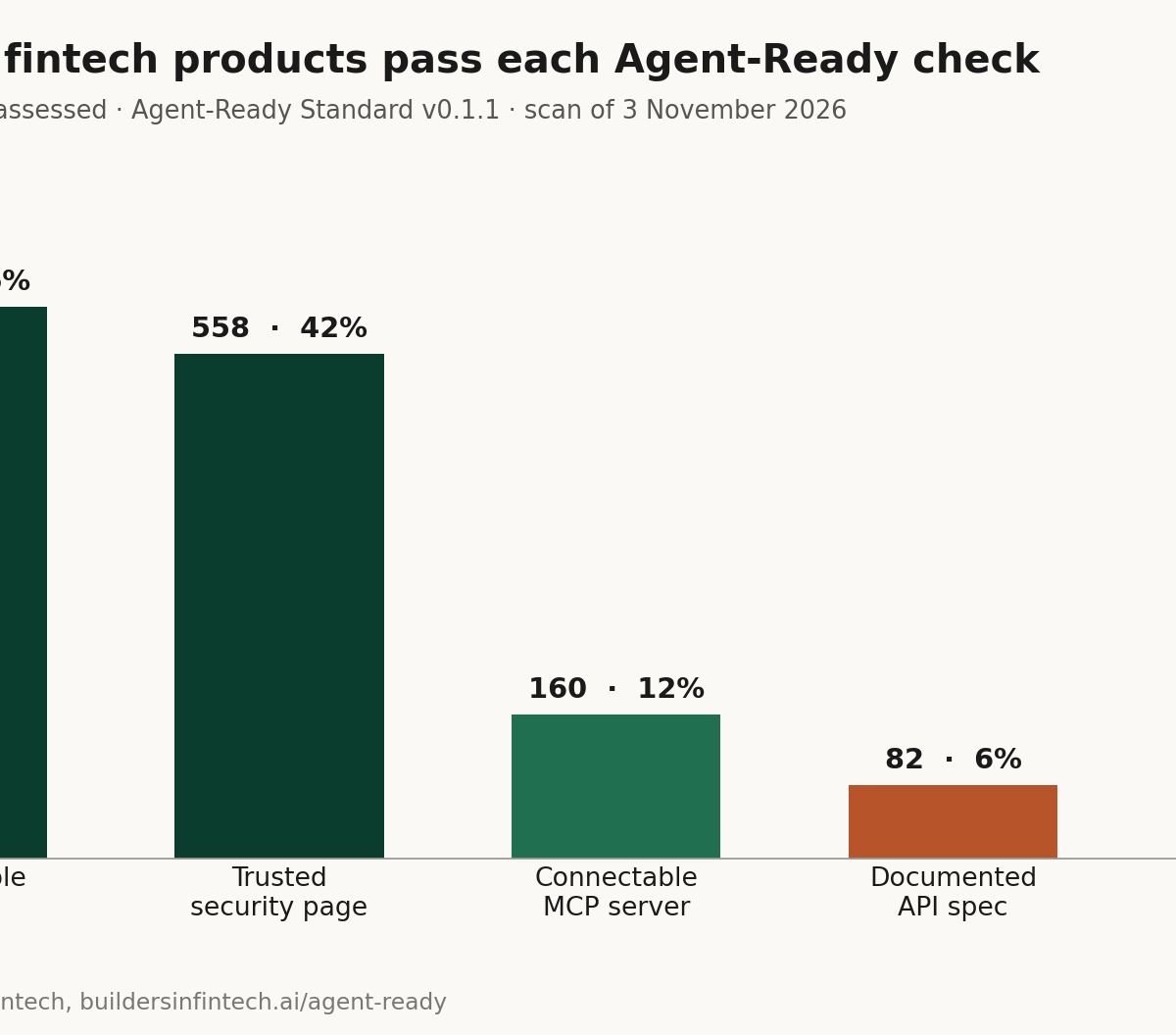
AI agents are starting to find, test and connect to financial products on their own. We checked 1,317 fintech products against five public signals that make that possible. The typical product passes one.
Between 26 October and 3 November 2026, Builders in Fintech scanned every product in its fintech database against the Agent-Ready Standard v0.1.1: can an agent find it, understand its API, try it without a sales call, connect to it directly, and see who runs it securely? Each check passes only on something public we can link to.
- 1,317 products assessed (75 more could not be loaded and are left out)
- Median score: 1 out of 5. One product in three scores zero.
- 9 products pass all five checks; 44 pass four or more (3.3%).
- 4.9% let an agent try the API through a self-serve sandbox. 6.2% publish a machine-readable API spec.
Key findings
- The cheap signals are spreading; the hard ones are not. Nearly half of products publish an llms.txt file or a security page, often switched on by their docs platform. Fewer than one in sixteen publish an API spec, and fewer than one in twenty let an agent test without talking to sales.
- More fintechs have an MCP server than a self-serve sandbox. 160 products run a product MCP server; only 65 offer a self-serve sandbox. Agents can increasingly connect to fintech before they can safely try it.
- Most new MCP servers are built for customers' assistants, not for developers. 98 of the 160 sit behind a standard OAuth login, typical of business apps letting users plug Claude or ChatGPT into their own account.
- "Has an MCP server" often means less than it sounds. Another 61 servers we found do not count: they only search documentation, are website chat assistants, or reject a standard client.
- Infrastructure leads, consumer finance lags. Open banking, identity and finance-operations tools score highest; insurance and consumer lending score lowest, and no insurance product offers a self-serve sandbox.
- Money helps, but not much. Series C-and-later companies are almost twice as likely as Series A ones to score 3 or more, yet the average late-stage product still passes fewer than two checks: funding buys documentation, not agent-readiness.
The five checks
The two checks most products pass are the ones a docs platform or a security team can switch on in an afternoon. The three that need product decisions, publishing a spec, opening a sandbox and running an MCP server, are where the field thins out. Scores pile up at the bottom: 432 products score 0, 479 score 1, 275 score 2, 87 score 3, 35 score 4 and 9 score 5.
One month on
The first scan ran on 26 October; this report uses the 3 November rescan. In between, 227 products joined the database and 31 products moved up a score, among them El Dorado (0 to 3), Elucidate (2 to 4) and Chift, which entered at 5 of 5. No product went down: the 14 drops the scanner reported were all cases of a site blocking our crawler on the second visit, and those products keep their October result. 35 further sites that answered in October blocked the November scan outright; they also keep their October result, dated as such on their page.
MCP: more servers than meets the eye, and fewer
The Model Context Protocol (MCP) is how an AI assistant connects to an outside service. We probed every product's site and docs for MCP endpoints and called each one we found.
What counts as connectable (160 products):
- 98 product servers behind OAuth. Payments, spend, accounting and banking apps such as Stripe, Plaid, Wise, Ramp, Qonto, Pennylane, Paddle and SumUp let a user log in and hand their assistant access to their own account.
- 29 documentation servers that can call the API. Docs platforms such as ReadMe and Mintlify now publish MCP servers that can make real API requests with the developer's key.
- 18 open product servers, 12 with API-token access and 3 others, from crypto infrastructure to tax and treasury tools.
What does not count (61 more): 47 servers only search the documentation, 10 are website chat assistants added by a site builder, 3 sit behind a login that a standard MCP client cannot complete, and 1 answers with an empty tool list. They help an agent read about a product; they do not let it do anything with it.
The pattern matters for buyers and builders alike: an "MCP" badge on a fintech homepage today can mean anything from a documentation search box to full account access.
Who is ahead
By category. Products built for other developers score highest; products sold to consumers score lowest.
| Category | Products | Average score | Connectable (MCP) | With a self-serve sandbox | | --- | --- | --- | --- | --- | | Open banking and data | 35 | 1.91 | 11 | 4 | | KYC and identity | 21 | 1.86 | 2 | 3 | | Finance operations and accounting | 141 | 1.61 | 35 | 5 | | Fraud and risk | 27 | 1.52 | 3 | 2 | | Compliance and RegTech | 40 | 1.45 | 5 | 0 | | Payments | 208 | 1.36 | 36 | 28 | | Crypto infrastructure | 110 | 1.32 | 13 | 10 | | Banking-as-a-Service | 42 | 1.19 | 0 | 6 | | Capital markets infrastructure | 52 | 1.17 | 9 | 1 | | Wealth and investing | 146 | 0.98 | 18 | 1 | | Digital banking | 103 | 0.84 | 11 | 2 | | Consumer credit and BNPL | 111 | 0.71 | 5 | 1 | | Lending infrastructure | 111 | 0.69 | 4 | 1 | | Insurance | 128 | 0.69 | 6 | 0 |
Finance-operations tools stand out: a quarter already pass the Connectable check, as accounting and spend platforms race to plug into their customers' AI assistants. Banking-as-a-Service is the surprise in the other direction: well documented, but not one of its 42 products passes the Connectable check.
By region. US products average 1.35 and account for 61 of the 160 products that pass the Connectable check. Continental Europe averages 1.08 and the UK 0.98. Sub-Saharan Africa trails at 0.58, with no product scoring 3 or more.
By funding stage. Among companies that raised since November 2023, 18% of Series C-and-later companies score 3 or more, against 13% at Series B and 10% at Series A. Seed-stage companies sit with Series A at 10%.
By regulation. Products with a licence we verified against a public register average 1.21, against 1.00 for regulated products we could not match to a register. Being licensed is no obstacle to being agent-ready.
The leaders
All five checks (9 products): Alchemy, Alpaca, Blockdaemon, Chift, Jithox, Kintsugi, PayMongo, Socure and Stripe.
The list mixes a global payments company with a Manila payment gateway, a Belgian unified-API platform, a crypto-infrastructure provider and a small payment-checks service built for agents from the start. What they share is not size but a habit: everything an agent needs is public, linked and self-serve.
Four of five (35 products): Acquired.com, Airwallex, Basiq, BitGo, BitPay, BR-DGE, Cashfree Payments, Coinflow, Dfns, Digits, Elucidate, Finix, Fonoa, Forter, HIFI, Infinia, Lean, Liberis, Lithic, Metronome, Modern Treasury, Paddle, Pinwheel, Plaid, Ramp, Razorpay, Ripple, Ryft, Splitit, Synctera, TabaPay, Wise, World, Zerion and Zero Hash.
The most common missing check is the sandbox (13 of the 35): they have one, but getting into it still goes through a sales conversation or a request form. Next come a public spec (8) and an MCP server (8).
Every product's result, with links to the evidence, is on its page on Builders in Fintech, and the full leaderboard is on the Agent-Ready page. We do not name products below four.
What a fintech can do this quarter
Each step below moves a product up one check, and most need no new product work.
- Publish an llms.txt file. Many docs platforms generate one with a setting; check your robots.txt does not block the main AI crawlers from your docs.
- Put your API spec where an agent can fetch it. Link the OpenAPI file from your docs, even if it lives on GitHub.
- Open a self-serve sandbox. Test keys on sign-up, no call required. This is the rarest signal in fintech and the one that most decides whether an agent can evaluate you.
- Ship an MCP server that does something. Let users connect their own account through standard OAuth, or let developers call your API through your docs server. A server that only searches your docs does not count.
- Publish a security page or a security.txt file. It takes an afternoon and tells an agent, and the person behind it, who to contact.
We rescan every product monthly, so improvements show up on its Builders in Fintech page within weeks.
Method and limits
- Scope. Every product in the Builders in Fintech database whose company is active, 1,392 in all. The database tracks fintech companies that raised funding or were covered in our news, so it leans toward funded, newsworthy companies rather than the whole market.
- Checks. The five checks of the Agent-Ready Standard v0.1.1, described in full on the Agent-Ready page. Each passes only on public evidence; a missed check means we did not find it, not that the product is worse.
- How. An automated scan of public pages on 3 November 2026 (first run 23–26 October), identifying itself as BuildersInFintech-AgentReady. Every MCP endpoint found was called to see what it does. Unclear sandbox wording (about 270 products) was checked by hand. A rescan never lowers a published result on its own: a check that goes missing on a later visit is reviewed by a person first.
- Corrections. Companies we were already in contact with were given a week to point us to anything missed before results went public, and every product page carries a link to send corrections. Twelve results were corrected by hand after review; each carries a dated note on the product's page.
- Not assessed. 75 products whose sites blocked automated visits or failed to load are left out of every figure, rather than scored zero. 35 products that answered in October but blocked the November scan keep their October result.
- Licences. Our register coverage spans the EU, UK, Switzerland, US, Canada, Australia, Singapore, India, Brazil, Colombia, Mexico and Argentina. Licence status is reported separately and never changes a score.
- Small groups. Figures for regions and stages with fewer than 50 products (seed stage, Latin America, Sub-Saharan Africa, Canada) are directional.