Weekly update #114
The latest news from the fintech and VC ecosystem

Welcome to this edition of the weekly newsletter. The idea behind this is to gather all the information in the startup ecosystem in one place, with a special focus on the fintech market and the VC industry.
Builders will be back next week! But you can still find all the episodes here on YouTube, or here on Spotify and here on Apple Podcast.
Coming back to us, this week I’ve been reading a very interesting report from FXC Intelligence , the “State of 2025 stablecoins in cross-border payments: the 2025 industry primer”. This study is a very interesting overview, updated year by year, on the overall market for stablecoins, including main routes, market opportunities, winner and losers. Here my main takeaways:
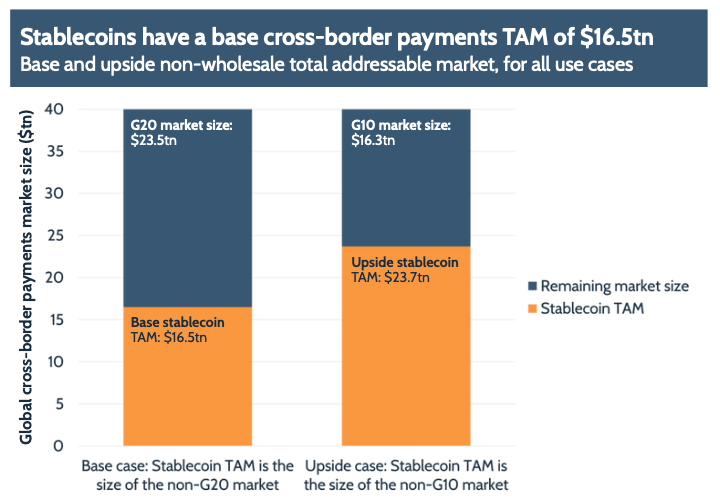
FXC Intelligence estimates the global cross-border payments market reached $194.8 trillion in 2024, with $40 trillion from non-wholesale flows. Stablecoins currently process only billions of dollars, representing under 1% of the market, but their addressable opportunity is far larger. Paxos’ Kendall argues a $250 billion stablecoin market cap is still small relative to institutions moving trillions. The strongest use cases are emerging-market corridors, where fees are high, opaque, and slow. Based on current flows, stablecoins’ base cross-border payments TAM is $16.5 trillion, rising to $23.7 trillion in an upside scenario.
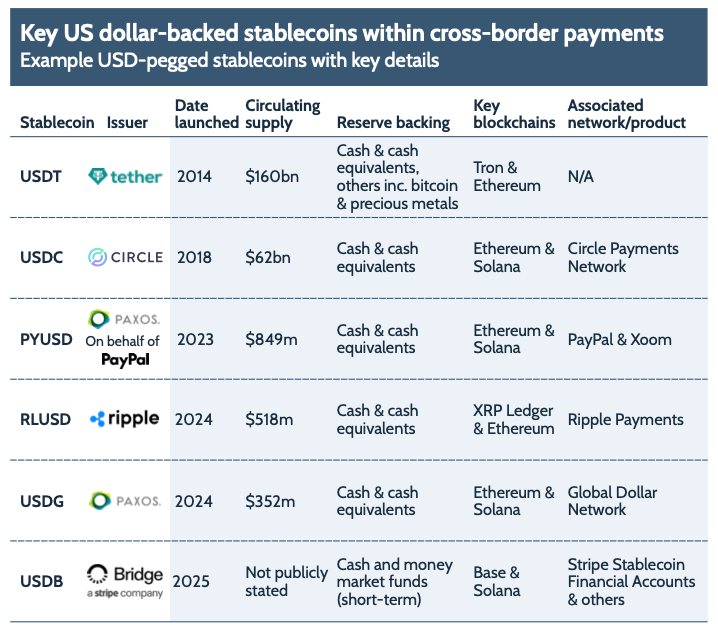
Although the market is becoming more and more competitive, only a subset of stablecoins is suitable for cross-border payments. Usability depends on reserve quality, transparency, scale, liquidity, and reliable API integration. As Higlobe’s Farman-Farmaian notes, deep multi-currency liquidity and resilient infrastructure are critical. Most payment-focused stablecoins are US dollar–pegged, led by Tether.io ’s USDT and Circle’s USDC. Others include PayPal’s PYUSD, used across PayPal and Xoom; Ripple’s RLUSD for its proprietary rails; Paxos’s USDG; and Stripe’s Bridge-issued USDB, which is restricted to internal network use.
Within the payments-focused stablecoin market, Tether’s USDT and Circle’s USDC dominate, together representing more than 80% of total market capitalization. USDT remains the larger asset, making it indispensable for certain use cases, while USDC’s scale positions it as the preferred option for many institutions. A key distinction lies in reserve composition: USDT holds a small portion of non-traditional assets such as bitcoin and precious metals, whereas USDC is fully backed by cash and cash equivalents held in US-domiciled banks.
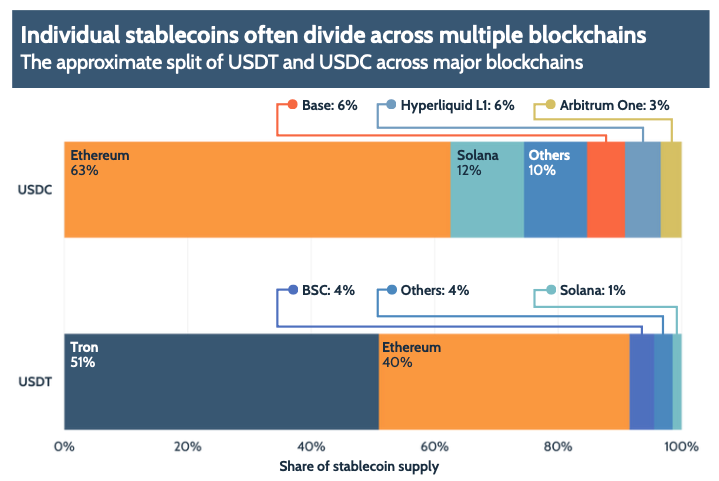
These factors, combined with USDT’s offshore reserve structure and lower transparency cadence, have limited its adoption among some US financial institutions, despite broad industry usage. On infrastructure, USDC supports 23 blockchains, though most circulation sits on Ethereum and Solana. USDT spans Ethereum but is primarily issued on TRON, which Circle exited in early 2024 due to compliance concerns.
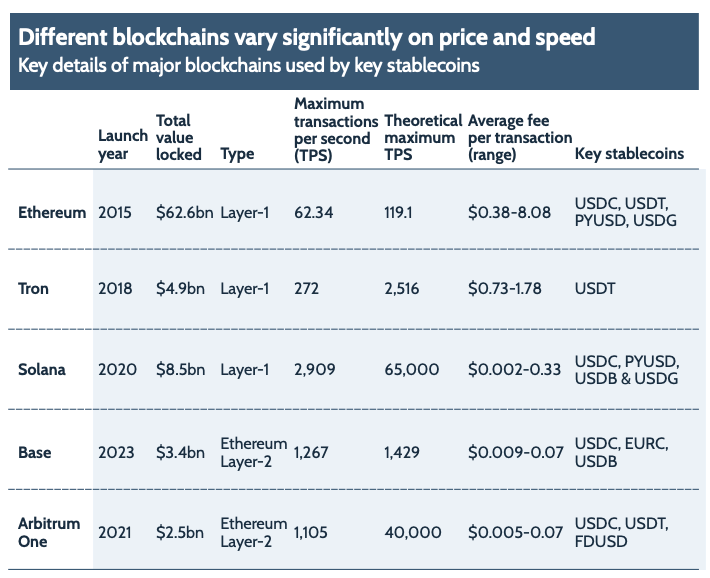
Firms using stablecoins for cross-border payments typically limit themselves to a small number of blockchains, as each network requires separate integration and introduces distinct standards that can create friction when assets move across chains. Among the most relevant networks, Ethereum and Solana illustrate key trade-offs. Ethereum leads in total value locked but has lower throughput and higher, volatile fees, while Solana supports far higher transaction volumes at minimal cost. To address Ethereum’s constraints, Layer-2 networks such as Base and Arbitrum-One offer faster settlement and lower fees, making them attractive for payment-focused use cases.
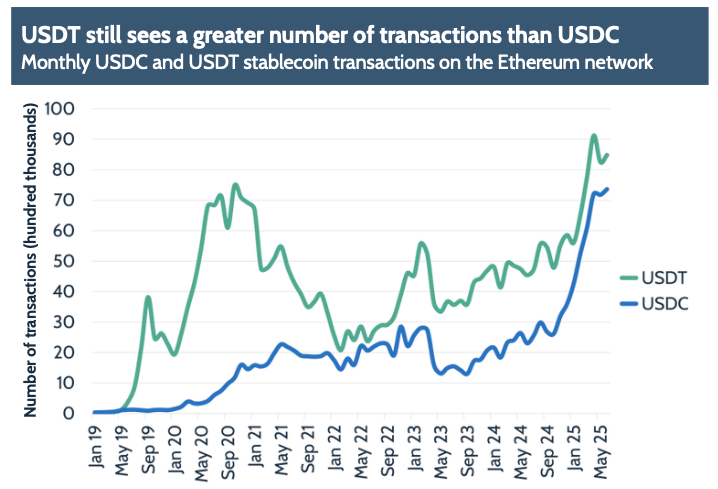
Although Tether’s USDT has a much larger supply than Circle’s USDC on the Ethereum network, transaction patterns reveal different usage. Despite USDT’s Ethereum supply being over 60% higher, transaction counts have been broadly similar since late 2024. More notably, USDC has recorded higher transaction volumes than USDT since November 2024, with the gap widening through early 2025. Average transaction values for USDC have also been consistently higher since 2020, suggesting it is more commonly used for larger-value transfers, while USDT continues to support frequent transactions across a wide range of use cases.
Anyway, we saw some very interesting news last week. Revolut is exploring acquisition of Turkish neobank FUPS, J.P. Morgan takes over the Apple card program from Goldman Sachs, Mollie joins EPI Company to bring Wero payments to merchants in Europe and Zilch acquires Fjord Bank. But a lot of acquisitions too! Flutterwave acquired open banking startup Mono, OceanFirst Bank acquired Flushing Bank and Fireblocks acquires TRES Finance. In the VC ecosystem, we saw Antler closing $510M in new funds, but also Lux Capital with a $1.5B fund, 4Founders Capital with a new $60M fund and Speedinvest with a $3M fund of funds to back emerging managers. In the Italian ecosystem, Satispay launched “Investimenti” to let users invest in managed funds. And finally, some very interesting funding round from fintech startups like Rain, Knight FinTech, Mylapay, Swap, SQRIL, Woliz and many others.
But let’s take a closer look at the main news of the last seven days.
Rounds
- Affiniti secures growth financing from HSBC to scale AI CFO platform for SMBs
- Knight FinTech raises $23.6M Series A to scale AI lending infrastructure
- Architect Financial Technologies raises $35M to scale AX perpetual futures exchange
- AI Insurer Nirvana Insurance raises $100M, valuation reaches $1.5B
- German insurTech Enzo raises €4m Seed extension to scale AI water damage prevention
- DSShield - درع الأمان الرقمي secures $54M investment from Merak Capital to accelerate cybersecurity expansion in fintech
- Octopus Energy spins out Kraken at €7.3B valuation after €850M raise
- Mylapay raises $1M to scale compliance first payment infrastructure
- Swap raises $100M Series C six months after $40M Series B
- Barclays invests in Ubyx Inc. to advance regulated tokenized payments infrastructure
- Tether.io invests on SQRIL to bring Stablecoin payments to QR networks in emerging markets
- Papaya Global in advanced talks for $3.5B–$4.5B sale
- VEON invests $20M in Mobilink Bank to scale digital and islamic banking in Pakistan
- Anthropic targets $10B raise at $350B valuation as AI capital concentrates
- Payhawk targets €1.71B valuation in new funding talks
- Pluto raises $8.6M to unlock liquidity from private market assets
- Moroccan fintech Woliz raises $2.2M Pre Seed to digitize small retailers
- Rain raises $250M Series C at $1.95B valuation to scale stablecoin payments
VC funds
- Antler closes $510M in new funds to expand global company building platform
- Lux Capital closes $1.5B Fund IX, its largest vehicle to date
- 4Founders Capital launches €60M hospitality fund targeting Spain’s tier 2 cities
- Speedinvest launches €3M fund of funds to back emerging VC managers
News on the market
- Meta acquires Manus AI for $2B, doubling down on revenue generating AI
- When coming to fintech, 2025 has one clear winner: Stablecoins.
- OceanFirst Bank to acquire Flushing Bank in $579M all stock regional banking merger
- Flutterwave acquires open banking startup Mono to deepen Africa’s payments infrastructure
- QNB Group expands Mastercard payment services into Syria
- Arab Financial Services launches licensed SoftPOS nationwide across Egypt
- Cross River and Highnote enable USDC settlement in Visa stablecoin pilot
- Brazilian digital bank PicPay files for U.S. IPO on Nasdaq
- Walmart’s OnePay brings crypto to cash utility to everyday retail
- GTreasury expands compliance automation with Solvexia acquisition
- Now it’s official, bunq files for a US banking license!
- Revolut explores acquisition of Turkish neobank FUPS!
- Crypto.com and Stripe bring crypto payments to everyday online commerce
- Coinbase pauses Argentine Peso on ramp months after market entry
- Zilch to acquire Fjord Bank to kickstart European expansion!
- J.P. Morgan to take over Apple Card issuance in landmark co-brand shift
- Mollie joins EPI Company to bring Wero payments to merchants across Europe
- Fireblocks acquires TRES Finance $13M to add audit ready crypto accounting
- Stripe partners with Microsoft to enable in chat commerce on Copilot
Italian market
- Satispay expands into investing with three new funds and Invesco partnership
And here some useful resources for everyone involved in the ecosystem:
Events you don’t want to miss
- FIBE | Berlin - 15th-16th April 2026 (Link here)
You have a cool event you want to mention or to sponsor? Feel free to send me a DM.
New funds
I recently spoke with Marco Scotti from Raspberry Ventures. Thanks to their Y Combinator Alumni network, they unlock access to the top 10% of YC companies for Angel investors. Co-investing up to $3M across 15 - 25 companies in each YC batch, 4 batches a year, before Demo Day; and before the Silicon Valley VCs come in and take allocations in the best companies.
Their next batch YC W26m is closing February 1st, 2026. You can take a look here if you are interested!
Take also a look at the last edition of the newsletter, Weekly update #113.
Topics
Related funding
| Company | Round | Amount | Date |
|---|---|---|---|
| SQRIL Added · · Weekly update #114 | 7 January 2026 | ||
| Nirvana Insurance Added · · Weekly update #114 | Series D | 100,000,000 USD | 18 December 2025 |
| Knight FinTech Added · · Weekly update #114 | Series A | 23,600,000 USD | 2 January 2026 |
| Ubyx Inc. Added · · Weekly update #114 | Strategic | 7 January 2026 | |
| Mylapay Added · · Weekly update #114 | Pre-Series A | 1,000,000 USD | 5 January 2026 |
| DSShield Added · · Weekly update #114 | 54,000,000 USD | 5 January 2026 | |
| Mobilink Bank Added · · Weekly update #114 | 20,000,000 USD | 8 January 2026 | |
| Architect Added · · Weekly update #114 | Series A | 35,000,000 USD | 23 December 2025 |
| Woliz Added · · Weekly update #114 | Pre-seed | 2,200,000 USD | 9 January 2026 |
| Swap Added · · Weekly update #114 | Series C | 100,000,000 USD | 7 January 2026 |
| Enzo Added · · Weekly update #114 | Seed (extension) | 4,000,000 EUR | 5 January 2026 |
| Pluto Added · · Weekly update #114 | Seed | 8,600,000 USD | 6 January 2026 |
| Rain Added · · Weekly update #114 | Series C | 250,000,000 USD | 9 January 2026 |
| Affiniti Added · · Weekly update #114 | 2 January 2026 |