Weekly update #111
The latest news from the fintech and VC ecosystem
Welcome to this edition of the weekly newsletter. The idea behind this is to gather all the information in the startup ecosystem in one place, with a special focus on the fintech market and the VC industry.
Builders is back with Season 3! In this episode, I sit down with Martin Della Chiesa, CEO at Skaleet. You can find the full episode here on YouTube, or here on Spotify and here on Apple Podcast.
Martin comes from a corporate finance and investment background, starting his career at Accuracy first, with a focus on strategy and financial services, and later on at Long Arc Capital, where he climbed the corporate ladder from associate until principal. At Long Arc, he discovered the passion for investments in high growth tech companies, backing multiple times between Paris and New York.
He joined Skaleet in 2023 as board member, and eventually became CEO in 2024, stepping in with a very operative role. Skaleet is a core banking solution designed with a logic of perpetual evolution, cloud-based, modular and 100% API, managing the technical infrastructure for over 30 high level financial institutions clients across EMEA.
With him, we talked about the journey from investments to a very operative role, the struggle of being a CEO, but also hiring and the upcoming challenges he sees in fintech moving forward.
Coming back to us, I’ve been reading a very interesting study this week, the “Riding the hyperscaler wave: the investment opportunity in cloud ecosystem” by McKinsey & Company. I’ve been working in a Data Center company for a while, and recently I am kind of shocked about the amount of investments in this field, obviously driven by the AI training wave. While we wait for Elon to build the first data center in space, here my main takeaway from the report:
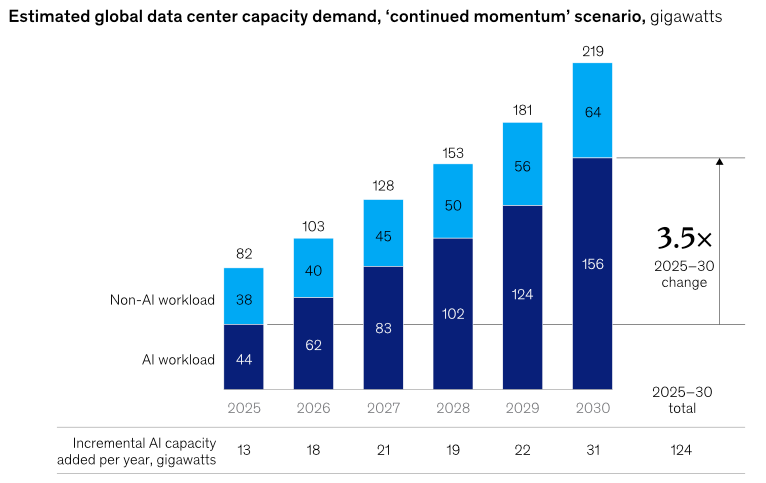
Let’s start from the basics, let’s begin with demand. Companies planning compute investments must begin with rigorous demand forecasting, yet the pace of change in AI makes this difficult. Global data center demand could almost triple by 2030, with roughly 70 percent driven by AI workloads. This outlook depends on the evolution of AI use cases, since enterprise adoption will determine whether compute needs fall short of or exceed expectations.
It also depends on rapid innovation cycles. In 2025, DeepSeek AI reported that its V3 model reduced training costs by about 18 times and inferencing costs by roughly 36 times versus GPT-4o. Such gains, however, may be absorbed by greater experimentation, limiting their long-term effect on compute demand.
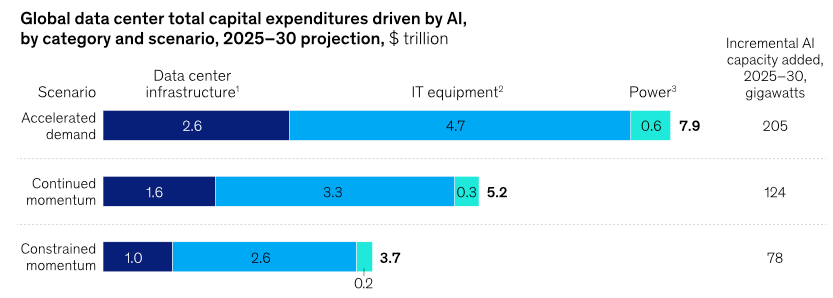
Meeting global AI demand will require an estimated $5.2 trillion in data center investments by 2030. This calculation is based on expected AI-related capacity of 156 GW by 2030, including 125 incremental GW added between 2025 and 2030. Scenario analysis shows the potential range of capital needs.
In an accelerated case, adding 205 incremental GW would require about $7.9 trillion. The central scenario results in $5.2 trillion, while a constrained case with 78 incremental GW would require $3.7 trillion. These figures illustrate the scale of capital needed to support AI-driven compute expansion over the next decade.
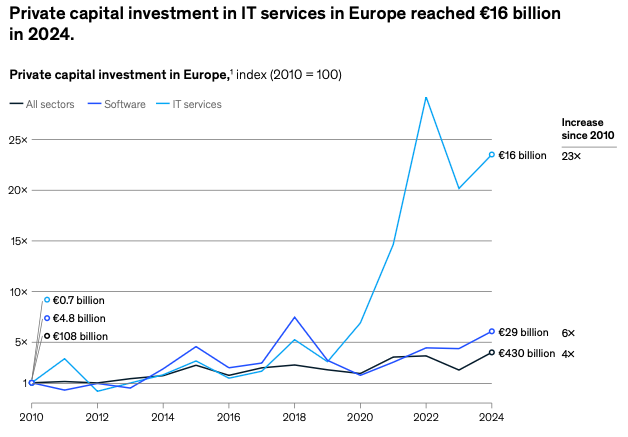
Since the early 2010s, cloud adoption has surged as enterprises moved major workloads to cloud environments to improve cost efficiency, resilience, agility, and innovation capacity. Today, more than 95 percent of organizations operate with a cloud footprint, and the share of enterprise workloads running in the public cloud has grown from 32 percent in 2018 to 52 percent in 2025. Public cloud consumption rose from approximately $90 billion in 2019 to $335 billion in 2024, and the sector could generate between $1.6 trillion and $3.4 trillion in revenue by 2040.
A small group of hyperscalers now represents about two-thirds of the public cloud market, supported by vast libraries of platform services and virtually unlimited scalability. Their expansion has fueled the rise of a global ecosystem of more than 500,000 partners providing software, implementation, integration, and managed services essential to adopting and operating cloud technologies at scale.
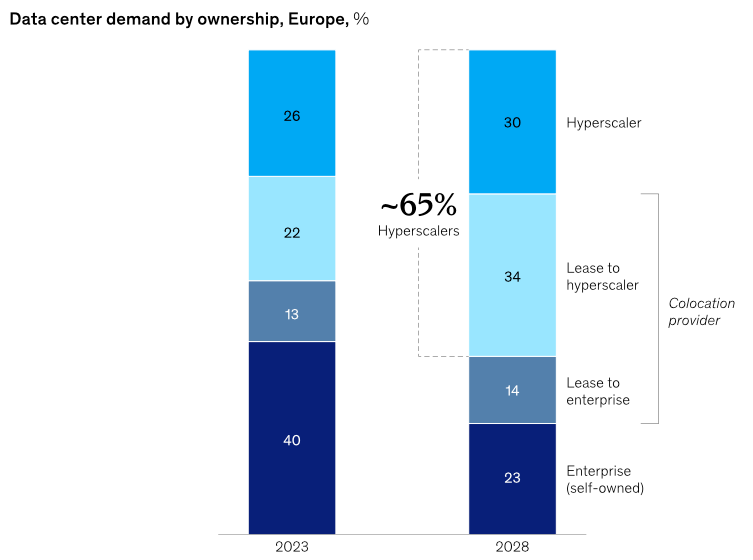
McKinsey estimates that AI and analytics could generate about $10 trillion in economic value, yet capturing even a quarter of this by 2030 would require an additional 50 to 75 GW of global data center capacity. In Europe, IT load demand is expected to rise from 10 GW in 2023 to roughly 35 GW in 2030. Data centers could represent 15 to 25 percent of all new net power demand through 2030, with electricity use increasing by about 85 TWh at a 13 percent CAGR. Growth is driven mainly by hyperscalers, which may account for up to 70 percent of demand by 2028.
Anyway we saw a lot of interesting news this week. Airwallex closed a $330M round at $8B valuation, Coinbase reopened onboarding for Indian customers, Revolut offered a shares buyback option to former employees at $75B valuation, and Zilch secured an FCA payment license in the UK. Lots of acquisitions! The most interesting one is obviously Mollie acquiring GoCardless for $1.5B, but also Paribu acquires CoinMENA for $240M, Stripe acquires Valora and Socure acquires Qlarifi. In the VC market we saw FoodLabs closing a $105M fund, Tiger Global targeting a new $2.2B one, and new funds from U2V, Catalpa Ventures and APEX . And finally, some very interesting funding rounds from fintech startups like Tuhk Inc., Coremont, GoDutch, Hnry, Bless Payments, Yonda and Ezeebit.
But let’s take a closer look at the main news of the last seven days.
Rounds
- Airwallex raises $330M at $8B valuation to scale global financial infrastructure
- Coremont secures €34M from Blue Owl Capital to scale institutional analytics platform
- MANNJAL raises ₹17.5 Crore Seed round to scale AI-ready lending infrastructure
- AllScale raises $5M Seed to build the world’s first self-custody stablecoin neobank
- Nuuvia’s CUSO raises $4M from VyStar Credit Union and Desert Financial Credit Union to scale youth banking platform
- Tuhk Inc. raises $6M Seed to launch real-time collaborative fraud platform across UK, US, and Canada
- European Investment Bank (EIB) backs Scalapay with €70M to accelerate BNPL innovation across Europe
- Paradigm leads $13.5M Series A into Brazil’s leading real-backed stablecoin Crown
- GoDutch raises €3.6M to cut SME financial admin by 70% with AI finance OS
- Mondu lands €100M J.P. Morgan debt facility to scale B2B payments across Europe
- Fibe.India (Formerly EarlySalary) secures $35M from World Bank’s IFC to scale responsible consumer lending
- Barclays backs United Fintech, joining board as fifth global bank investor
- Hnry raises $30M+ to accelerate global expansion across NZ, Australia, and the UK
- Surf AI secures $15M to advance AI models for digital asset intelligence
- AIR Platforms raises $6.1M to modernize real-time credit intelligence with AI
- AI fintech platform Bags raises $2.75M to scale small business financial intelligence
- Bless Payments secures $3.75M Seed to accelerate global remittance expansion
- Yonda Tax secures $15M to scale global compliance automation
- Ezeebit raises $2.05M seed round to scale crypto payments across Africa
VC funds
- FoodLabs closes €105M third fund to back Europe’s next wave of food, agri, and health startups
- Tiger Global targets more cautious new $2.2B venture fund
- U2V closes first €60M fund to scale Europe’s deeptech university spin-offs
- Catalpa Ventures closes first €30M healthtech fund to tackle Europe’s care crisis
- APEX launches €300M PE fund targeting European football and motorsport
- KBC Group Re unveils €100M fund to power Belgium’s next generation of scale-ups
News on the market
- Paribu acquires CoinMENA in a $240M deal to expand across MENA
- UK Financial Conduct Authority to introduce 18-month provisional licences for fintech startups
- Coinbase reopens India onboarding, targets fiat on-ramp in 2026
- Socure acquires Qlarifi to build unified BNPL credit and fraud infrastructure
- Robinhood enters Indonesia through dual acquisition of brokerage and crypto trader
- Aspire expands Wise-powered cross-border payments to Hong Kong
- Revolut offers former employees discounted liquidity at $75B valuation
- Instacart launches first in-chat grocery checkout inside OpenAI’s ChatGPT
- BMW Group adopts J.P. Morgan’s tokenized deposits to automate global treasury flows
- Mollie in talks to acquire GoCardless in potential $1.5BB deal
- Fifth Third Bank and Brex AI-powered commercial card partnership
- Zilch secures FCA payments license ahead of ZilchPay launch
- Now it’s confirmed: Mollie acquires GoCardless for €1.5B to form a €3.5B European payments leader
- Klarna partners with Privy to develop a new mainstream crypto wallet
- Stripe acqu-hires Valora’s team to accelerate its expansion into crypto infrastructure
- Klarna expands Apple Pay installments to France and Italy
- Tools for Humanity platform World introduces new ‘Super App’ with encrypted chat and crypto payments
- Tether.io blocks secondary share sales as it seeks pp to $20B at a $500B valuation
Italian market
- OSL Pay selects Milan for European launch and appoints Orlando Merone as general manager
And here some useful resources for everyone involved in the ecosystem:
Events you don’t want to miss
- FIBE | Berlin - 15th-16th April 2026 (Link here)
You have a cool event you want to mention or to sponsor? Feel free to send me a DM.
New funds
I recently spoke with Yotam Rosenbaum, one of the more active YC investors you’ve probably never heard of. Over the past few years he’s invested in more than 400 YC-backed startups, and earlier this year he launched a new fund, First Peak Ventures, built around a simple but increasingly relevant insight: if you want meaningful YC exposure today, you can’t start at Demo Day, you have to start before Demo Day.
For readers who follow YC closely, First Peak is a fund worth keeping an eye on. If you want to take a look at what they do, you can do so here.
Take also a look at the last edition of the newsletter, Weekly update #110.
Topics
Related funding
| Company | Round | Amount | Date |
|---|---|---|---|
| Nuuvia Added · · Weekly update #111 | 4,000,000 USD | 9 December 2025 | |
| AllScale Added · · Weekly update #111 | Seed | 5,000,000 USD | 8 December 2025 |
| Paradigm Added · · Weekly update #111 | Series A | 13,500,000 USD | 10 December 2025 |
| Fibe.India Added · · Weekly update #111 | Series F | 35,000,000 USD | 9 December 2025 |
| Mondu Added · · Weekly update #111 | Debt facility | 100,000,000 EUR | 10 December 2025 |
| Coremont Added · · Weekly update #111 | 34,000,000 EUR | 8 December 2025 | |
| GoDutch Added · · Weekly update #111 | Seed | 3,600,000 EUR | 9 December 2025 |
| MANNJAL Added · · Weekly update #111 | Seed | 175,000,000 INR | 8 December 2025 |
| AIR Platforms Added · · Weekly update #111 | Seed | 6,100,000 USD | 11 December 2025 |
| Scalapay Added · · Weekly update #111 | 70,000,000 EUR | 10 December 2025 | |
| United Fintech Added · · Weekly update #111 | Strategic | 10 December 2025 | |
| Airwallex Added · · Weekly update #111 | Series G | 330,000,000 USD | 8 December 2025 |
| Yonda Added · · Weekly update #111 | 15,000,000 USD | 11 December 2025 | |
| Surf AI Added · · Weekly update #111 | 15,000,000 USD | 11 December 2025 | |
| Tuhk Inc. Added · · Weekly update #111 | Seed | 6,000,000 USD | 10 December 2025 |
| Bags Added · · Weekly update #111 | 2,750,000 USD | 8 December 2025 | |
| Ezeebit Added · · Weekly update #111 | Seed | 2,050,000 USD | 9 December 2025 |
| Hnry Added · · Weekly update #111 | Series C | 30,000,000 NZD | 8 December 2025 |
| Bless Payments Added · · Weekly update #111 | Seed | 3,750,000 AUD | 7 December 2025 |