Weekly update #145
The latest news from the fintech and VC ecosystems

Welcome to this edition of the weekly newsletter. The idea behind this is to gather all the information in the startup ecosystem in one place, with a special focus on the fintech market and the VC industry.
Builders is on pause for the rest of August. The podcast will be back in September with season 5! But you can always recover all episodes here:
If you are interested in joining me on the podcast, feel free to drop a message on Linkedin! always looking forward to speak with the best founders and VCs in the market!
Coming back to us, this week I’ve been speaking with David Ruda, VP of software products at Billtrust.

Dave has over 15 years of experience in product management, marketing technology, e-commerce, and web analytics, from fintech to software development. Started his career at Experian, moving then to Hewlett Packard Enterprise, TravelClick and finally Billtrust.
Billtrust is a B2B accounts receivable workflow and payment software. Their AI-powered solutions simplify the AR lifecycle - from rapid digital invoice distribution to easy payment application.
With him, we have been talking about the impact of AI on software products, but also on how the “buy or build” question is reshaping in 2026.
M: How do you separate AI that creates real value from AI that’s just theater, and what does that filter look like when your team decides what’s worth building?
B; The filter is simple to say and hard to hold to. We need to consider whether it removes a specific, named piece of pain for a specific person, or is it just AI added on top of a feature because AI is what you’re supposed to have right now? In Accounts Receivable (AR), we start by interviewing the frontline users, such as the collector, the credit analyst, and the team running the cash application, to map where their actual time is going, particularly the repetitive or manual tasks that slow them down
The version that’s just for show almost always shows up as something technically clever that nobody asked for. However, the real version quietly turns an eight-minute task into a two-minute one, without needing a slide to sell it because the user tells you. Ultimately, that’s what matters.
M: In fintech, the cost of a wrong answer is high; a single mistake can be expensive. How does that shape your approach to human-in-the-loop design, and where do you draw the line between what an agent handles on its own and what still needs a person?
B: Human-aided automation should always precede unaided automation. AI should act as a copilot, not the captain of the program.
Practically, that means we start with human-in-the-loop, where the agent drafts, recommends, or prioritizes and a human approves key actions and activities before anything goes out or any dollar moves. As the model earns trust through lower-stakes, high-volume decisions, the human-on-the-loop process can be adjusted accordingly, which might really just require visibility. In essence, you see the agent act, and a person can see what it’s doing and step in when needed.
What doesn’t move to full autonomy are decisions with real financial or relationship consequences, like extending credit or writing off a balance. Evidence and confidence scores travel with every recommendation, so even when a human is the one approving, they’re not approving on faith.
M: How do you decide which bottlenecks are worth automating first, and how do you resist the pull toward flashier use cases over the unglamorous, high-volume ones that often matter more?
B: We look for where manual effort is highest and most repetitive. For instance, paper checks still account for roughly 26% of B2B payments, which is a reminder of how much manual work remains in the payments process. Sometimes the most valuable automation is simply taking a manual process that happens thousands of times a day and making it disappear.
The unstructured inbox, hundreds of payment promises, disputes, and partial responses landing on a collector’s desk every day are not glamorous problems, but they’re the ones eating people’s entire day.
More visible, impressive use cases are easy to pitch internally because they’re easy to visualize. High-volume, unglamorous areas of manual work are harder to pitch because they sound less exciting in a roadmap review, but they are where the actual hours and the actual cash are sitting.
What we’re really trying to do is put a data scientist on every collector’s shoulder. The value of that approach is measurable too. Our own numbers make the case for us, with teams tripling their capacity for collections outreach. It isn’t a flashy story, but it’s the kind of result that has a real impact on a business’s profit and loss.
M: As you roll out more agentic capabilities, how do you decide the sequence — which decisions to let an agent make first — and what has to be true before you widen an agent’s autonomy?
B: Gartner predicts that by 2028, at least 15% of day-to-day work decisions will be made independently through agentic AI. As that shift accelerates, the question becomes where to give an agent autonomy and where not to. We sequence by reversibility and volume. Decisions that are high-volume, low-stakes, and easy to reverse go first, such as how to prioritize a collections worklist or which channel to use for outreach and when to use it. Decisions that are low-volume but high-stakes, or hard to unwind, like credit limits or dispute write-offs, go last, and often never go fully autonomous.
Before we widen autonomy on anything, three things have to be true. Firstly, the model has been tested against a real, messy dataset, not a clean sample. Also, a person has watched it operate long enough to trust the pattern of its mistakes as well as its successes. And there’s a feedback loop that lets the system get smarter from what it gets wrong, not just what it gets right.
M: Billtrust sits on a large proprietary network of buyers and decades of payment data. In a world where anyone can wrap a foundation model, how much of the moat is the model versus that data — and how do you think about defensibility as AR software gets commoditized by AI?
B: Wrapping a foundation model around a workflow is becoming the standard now. Almost anyone can do it, and that’s exactly why it’s not a moat. What we have always said we want to give teams is a data scientist on their shoulder, and that only works if the shoulder has something real to draw on.
At Billtrust, we have 25 years of behavioral data across 13 million buyers and more than $1 trillion in annual invoice volume. A model wrapped around a generic LLM doesn’t know anything about how your buyers actually behave until it’s watched them behave. Our model doesn’t start from zero on day one, as it already has a meaningful understanding of how a given customer’s buyers pay, when they pay and where payments are likely to get stuck, because the network has already seen it play out many times over across our dataset.
M: How do you decide what to build in-house versus rent from foundation-model providers? Where’s the line between commodity intelligence you rent and the parts you have to own?
B: A foundation model on its own is a blunt instrument. It’s general-purpose by design, which is exactly why we don’t try to build our own. Reading an email, summarizing a document and drafting a response are solved problems, and there’s no advantage in re-inventing them.
What turns a blunt instrument into something precise enough to trust with a customer is everything we build around it. That’s the behavioral data, the deterministic business logic that encodes how credit, collections, and cash application actually work, and the layer that makes a model’s output specific enough to defend to an auditor.
So the line isn’t really build versus buy, but rather raw versus refined. The foundation model is the raw material, and the intelligence that makes it trustworthy in accounts receivable, grounded in real payment behavior and the way businesses get paid, is the part we have to build and keep building ourselves.
M: Shipping AI into finance is often less about the model and more about getting a skeptical end user to adopt it. What’s hardest about that, and what actually changes people’s minds?
B: Finance and accounts receivables professionals are risk-averse for good reason, as they are the ones who have to defend every number to a board or an auditor that directly affects cash flow, collections and customer relationships. So a black-box recommendation is a non-starter no matter how accurate it is. AI on its own is a blunt instrument and capable of creating as many problems as it solves. Guided by human expertise, though, it turns into something precise enough to actually trust.
What changes minds is watching the tool fit into work that teams are already doing, whether that’s prioritizing collections, reviewing payment behavior and seeing that it gets the recommendation right. Adoption follows trust, and trust is built one transparent, correct recommendation at a time.
M: When the product is an agent that acts on its own, “time saved” only tells part of the story. What signals would warn you that an agent is quietly making things worse before a customer notices?
B: Time saved is easy to celebrate and easy to be misled by. The signals to watch out for are what happens downstream. Is the agent’s outreach strengthening customer relationships as well as hitting volume targets? Are complaints, disputes and escalations staying at healthy levels, and are buyers responding positively to the way they’re being contacted? Those are the signals that tell us whether the system is working as intended.
A static approach that treats every account the same is really just casting the same net in the same spot every day and hoping for a good catch. If there is a pattern creeping back in even inside an automated system, that’s a sign we need to adjust the approach.
Another important signal is whether humans are still meaningfully reviewing the agent’s recommendations. If a human-in-the-loop step stops adding value, that’s not necessarily proof the agent has got better. It may be a sign that the review process needs to evolve. These signals create an opportunity to adjust and improve the system before they affect the customer.
M: With economic pressure pushing many companies to get paid slower, does that make finance teams more open to handing AI control, or more risk-averse? And looking five years out — what’s the job you think AI never takes over?
B: The answer is both, and that tension is the story of finance right now. Teams are under real pressure to do more with fewer people, which pushes them toward automation, but at the same time, mistakes can be very expensive, which may inadvertently make teams more cautious.
What we see is that pressure doesn’t make teams reckless with AI, but instead it makes them more deliberate about where they apply it, favoring the high-volume, defendable use cases over the flashy, unproven ones.
Five years out, the job AI doesn’t take over is the relationship with customers. It’s the judgment call on when to extend grace to a long-standing customer going through a rough quarter, or the negotiation that keeps a buyer relationship intact while still getting paid. AI can tell you who’s at risk and why with more evidence than any spreadsheet ever could. Deciding how to handle a difficult customer situation, balance the commercial relationship, and ultimately get paid is still a human call.
But let’s take a closer look at the main news of the last seven days, Revolut secures a full banking license in France, Robinhood brings crypto trading to his UK app, N26 launches Wero in Germany and France and Klarna wants to challenge traditional credit cards program in partnership with Zilch. But also, etoro acquires TradeZero for $231M, Bitwise cuts 14% of the workforce, Revolut launches an European network of airport lounges and Coinbase brings 24/5 US stock trading to their UK customers. In the VC market, Accel raises $3.5B across 4 new funds, 224 Ventures launches a $100M fund to invest in AI startups, Team8 raises $365M across 2 new funds, but also new vehicles from Cross-Border Impact Ventures, Mido Capital, GEM and K2 Global. And finally some very interesting funding rounds from fintech startups like River Markets (YC P26), Yuno, Axle, Activitis, Lovable, FAZ Cred and many others.
Let’s take a closer look:
Rounds
- Erebor nears $1.5 billion raise at $8 billion valuation
- Traydstream secures strategic investment from Mashreq’s NeoVentures
- Activitis plans $85M raise to scale digital finance in Ukraine
- HSBC Asset Management invests in Model ML as funding tops $100M
- Quartr raises €15.6M to expand AI ready public company data
- Yuno raises $45M to build an AI native operating system for global payments
- Axle raises $17.5M Series A to scale AI native insurance infrastructure
- Lovable raises $400M Series C at a $13.3B valuation
- FAZ Cred raises R$80M FIDC to scale private payroll lending in Brazil
- UBS invests in Finster AI to advance investment banking automation
- Future FinTech Group Inc. raises $30M through private Nasdaq stock sale
- River Markets (YC P26) raises $8.5M to build institutional prediction market infrastructure
- Thrive Holdings raises $2B at $12B valuation to scale AI powered PE acquisitions
VC funds
- 224 Ventures launches with $100M to back AI native startups
- Accel raises $3.5B across four new funds to back the next generation of tech startups
- Cross-Border Impact Ventures raises $58M first close for $125M women’s health tech fund
- Former a16z speedrun partner Bryan Kim launches $100M Mido Capital
- Team8 raises $365M across two funds for AI native startups
- Lightspeed seeks $600M to extend stakes in OpenAI, Anthropic and AI Leaders
- Bitget launches $300M institutional capital program
News on the market
- Revolut secures full banking license in France
- Coinbase brings 24/5 US stock trading to UK users
- etoro and Papaya Global connect payroll directly to investing
- Robinhood brings crypto trading to its main UK app
- Stripe owned Bridge joins EU MiCA register
- Aspire partners with Flagright to strengthen AI driven financial crime compliance
- MoonPay’s Iron launches stablecoin infrastructure APIs for businesses
- Commerzbank AG CEO opens door to UniCredit tie up
- MetaMask launches agent wallet for AI driven onchain execution
- Adyen expands Toast partnership into the U.S.
- UnionPay International plans to connect Chinese payment apps to Brazil’s Pix
- Circle launches AI agent discovery layer for USDC payments
- EU to review MiCA rules for non EU stablecoins
- etoro to acquire TradeZero for up to $231M as equities drive Q2 growth
- RBC and BMO sell Moneris to Francisco Partners for C$2 Billion
- N26 launches Wero for instant European payments in Germany and France
- Revolut plans European airport lounge network starting in Copenhagen
- Klarna and Zilch launch paid membership plans to challenge credit cards
- Bitwise Asset Management cuts 14% of workforce amid crypto market pressure
- Anthropic in talks to acquire Decart AI for around $6B
And here some useful resources for everyone involved in the ecosystem:
Events you don’t want to miss
- Global Fintech Fest 2026 | Mumbai | 9-11 September (link here)
- Money 20/20 Middle East | Riyadh | 14-16 September (link here)
- European blockchain week | Barcelona | 16-17 September (link here)
- Nordic fintech week | Copenhagen | 23-24 September (link here)
- Korea Blockchain Week 2026 | Seoul | September 29 - October 1 (link here)
- TOKEN2049 | Singapore | 7-8 October (link here)
- Money 20/20 USA | Las Vegas | 18-21 October (link here)
- MERGE Madrid 2026 | Madrid | October 27-29 (link here)
- Hong Kong fintech week | Hong Kong | 02-06 November (link here)
- Africa Stablecoin Summit 2026 | Johannesburg | 12-13 November (link here)
- Solana Breakpoint 2026 | London | 15-17 November (link here)
- Singapore FinTech Festival 2026 | Singapore | 18-20 November (link here)
- Fintech Nerdcon | San Diego | 19-20 November (link here)
- Bitcoin MENA 2026 | Abu Dhabi | 7-8 December (link here)
- Abu Dhabi Finance Week 2026 | Abu Dhabi | 7-10 December (link here)
- TOKEN2049 Dubai 2027 | Dubai | 21-22 April, 2027 (link here)
- Money20/20 Asia 2027 | Bangkok | 27-29 April, 2027 (link here)
You have a cool event you want to mention or to sponsor? Feel free to send me a DM.
Founders to watch in fintech
I also wanted to start shining a light on the most interesting fintech founders out there, so I thought to start sharing how I look for ideas to invest on. Every week, I will start sharing the most interesting founders in fintech, divided per area.
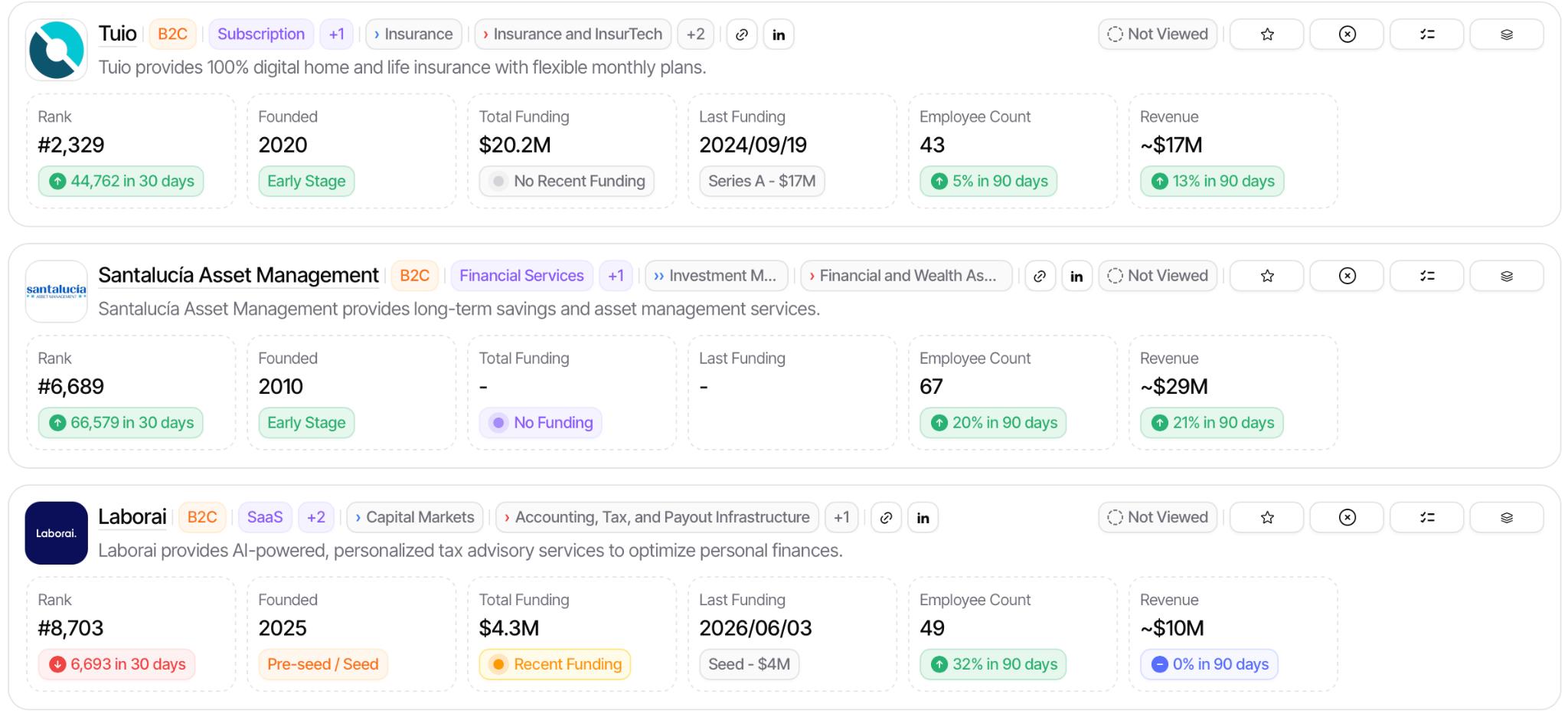
This week I took a look at the most interesting fintech startups in Madrid, focusing on companies bootstrapped in the early stage (pre-seed and seed).
I usually use Spectre to scout for new ideas, the team is great and they also give me a free account once they learned I was a fan of the product. So if you wanna take a look at it, you can find it here.
VCs and PEs raising new funds now
I would like to leave this part of the newsletter as space for VC and solo GP that are launching new funds right now. I frequently speak with GPs and LPs, and I like the idea of giving them a showcase where to announce what they are doing. Here the new funds raising right now that I have been talking with:
- Parallax Ventures, a fintech VC fund focused on Latam. They closed Fund I with a strong +50% IRR and 0.7x DPI, and are now raising Fund II. Take a look here if you want to know more or reach out directly to the GP at gennari@parallax.vc for details.
- Founder Factor, VC focused on YC companies, that just closed investments on the latest YC W26. They are expanding the current vehicle to double down on the current batch. You can take a look here if you are interested.
- RedFish Capital Partners, a private equity investor focused on Italian SMEs in growth and mature capital phases, with a track record exceeding 40% IRR and with over €200M in Assets. Currently raising its brand new AIF, which has already secured a soft commitment from the European Investment Fund (EIF). You can check them out at redfish.capital or contact the team at investor.relations@redfish.capital.
Overall, very interesting to see where the VC ecosystem is heading recently, between new emerging managers, solo GP and micro funds.
Always happy to support if I can! If you are raising a fund and you want to be listed here send me a message on Linkedin.
And finally, take also a look at the last edition of the newsletter, Weekly update #144
Topics
Related funding
| Company | Round | Amount | Date |
|---|---|---|---|
| Axle Added · · Weekly update #145 | Series A | 17,500,000 USD | 11 August 2026 |
| Traydstream Added · · Weekly update #145 | Strategic | 11 August 2026 | |
| Finster AI Added · · Weekly update #145 | 17 August 2026 | ||
| Lovable Added · · Weekly update #145 | Series C | 400,000,000 USD | 13 August 2026 |
| FAZ Cred Added · · Weekly update #145 | FIDC | 80,000,000 BRL | 17 August 2026 |
| Model ML Added · · Weekly update #145 | 17 August 2026 | ||
| River Markets Added · · Weekly update #145 | Seed | 8,500,000 USD | 11 August 2026 |
| Thrive Holdings Added · · Weekly update #145 | 2,000,000,000 USD | 17 August 2026 | |
| Yuno Added · · Weekly update #145 | Series B | 45,000,000 USD | 12 August 2026 |
| Future FinTech Group Inc. Added · · Weekly update #145 | 30,000,000 USD | 17 August 2026 | |
| Quartr Added · · Weekly update #145 | 15,600,000 EUR | 11 August 2026 |