Weekly update #130
The latest news from the fintech and VC ecosystems
Welcome to this edition of the weekly newsletter. The idea behind this is to gather all the information in the startup ecosystem in one place, with a special focus on the fintech market and the VC industry.
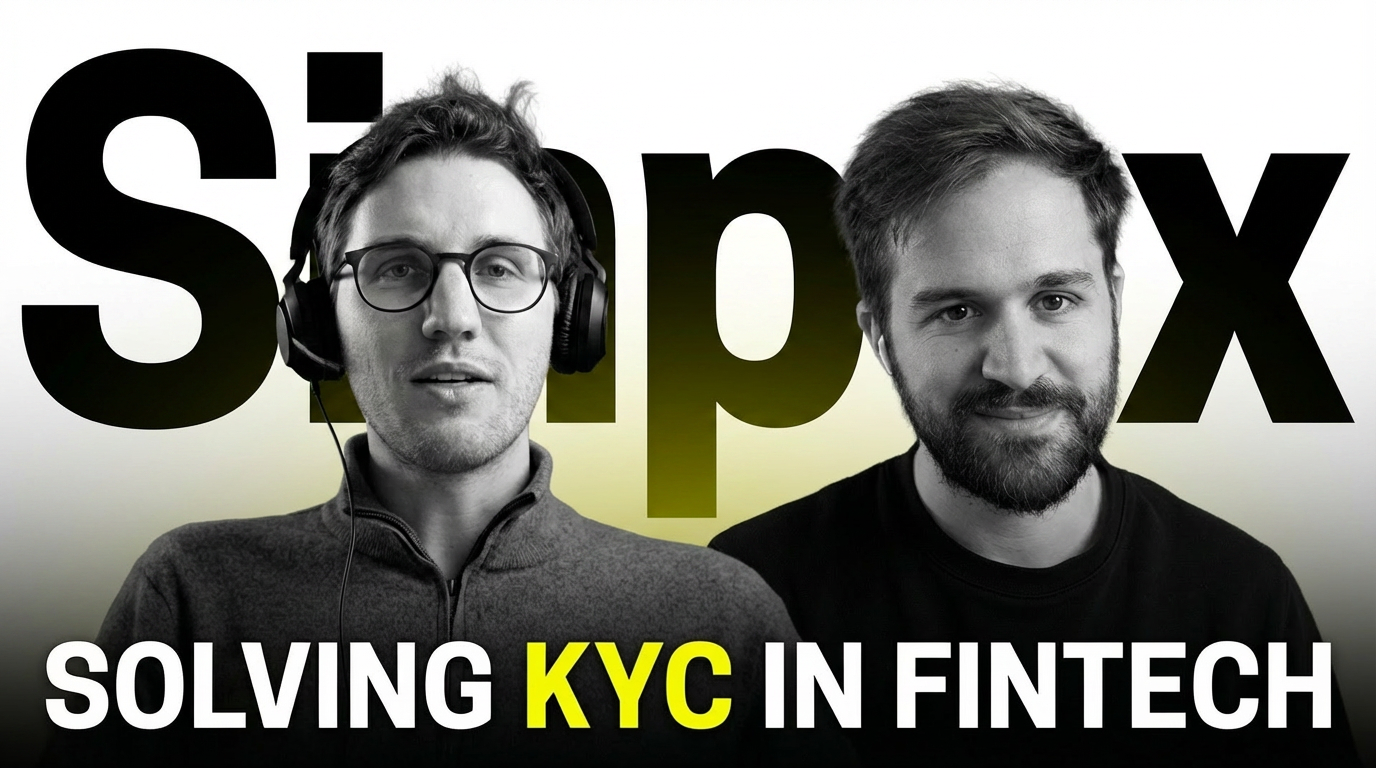
The latest episode of Builders has been released this week! In this episode, I sit down with Dr. Camillo Werdich , CEO and Founder of Sinpex. You can watch the full episode here on YouTube, or listen to it here on Spotify, here on Amazon Podcast or here on Apple Podcast.
Camillo is the CEO and Founder of Sinpex, an AI-driven compliance platform focused on transforming how financial institutions manage KYC, onboarding, and regulatory workflows. Since founding the company in 2019, he has led the development of solutions leveraging large language models to improve data accuracy, automate document analysis, and adapt quickly to evolving regulatory requirements.
He brings a strong blend of technical and financial expertise, with early experience in engineering roles at ZF Friedrichshafen and Transsolar, followed by consulting at Deloitte, where he gained exposure to complex business and regulatory environments.
Dr. Werdich holds a PhD in Economics from the Universität St. Gallen-Hochschule für Wirtschafts-, Rechts- und Sozialwissenschaften, complemented by academic experience at the The London School of Economics and Political Science (LSE) and a cum laude MSc in International Business. His work sits at the intersection of AI, compliance, and financial services innovation.
With him, we will talk about how necessary and complex is KYC in fintech today, the struggle with data sources for KYB, and why regulations is critical for innovation.
Coming back to us, this week I’ve been reading a very interesting report, the “Next age of fintech” by McKinsey & Company. The report is a comprehensive study on the fintech market, including present and future trends, funding rounds, but also main revenue analysis, geography concentration and upcoming IPOs. Here are my main takeaways.
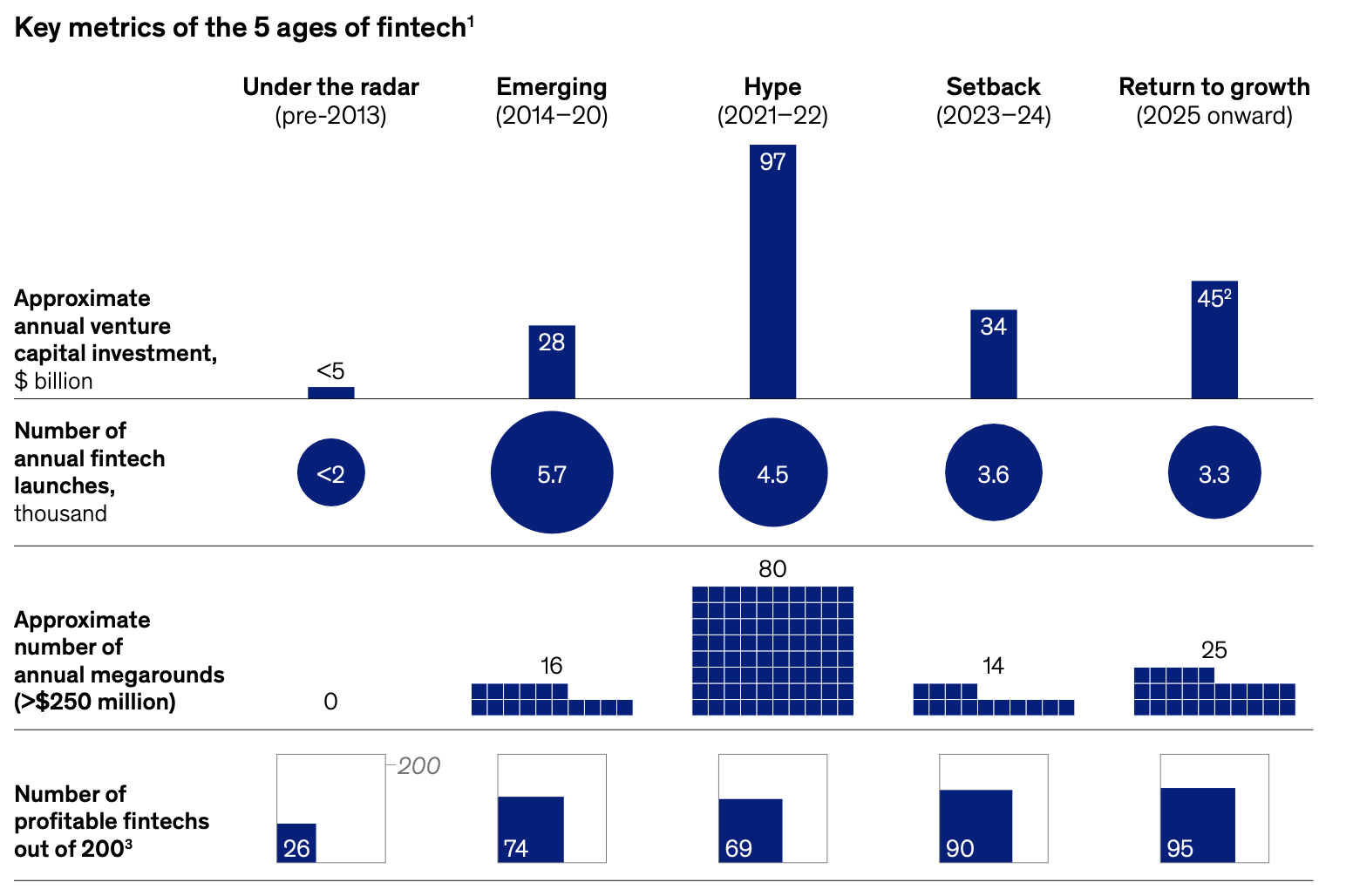
Fintech has reached a meaningful scale globally, with estimated revenues of around $650 billion in 2025, accounting for approximately 4 percent of the total financial services industry. At this level, fintech revenues exceed the GDP of several countries, including Norway, the Philippines, and Singapore, underlining its growing economic relevance.
The broader financial services sector also performed strongly in 2025, expanding by 6 percent and generating about $15.5 trillion in total revenue. However, fintech significantly outpaced the industry, recording year over year growth of roughly 21 percent, which is about 3.5 times faster than traditional players.
If this trajectory continues, fintech could grow into a $2 trillion market by 2030, effectively tripling in size and increasing its share of the global financial services value pool to around 9 percent.
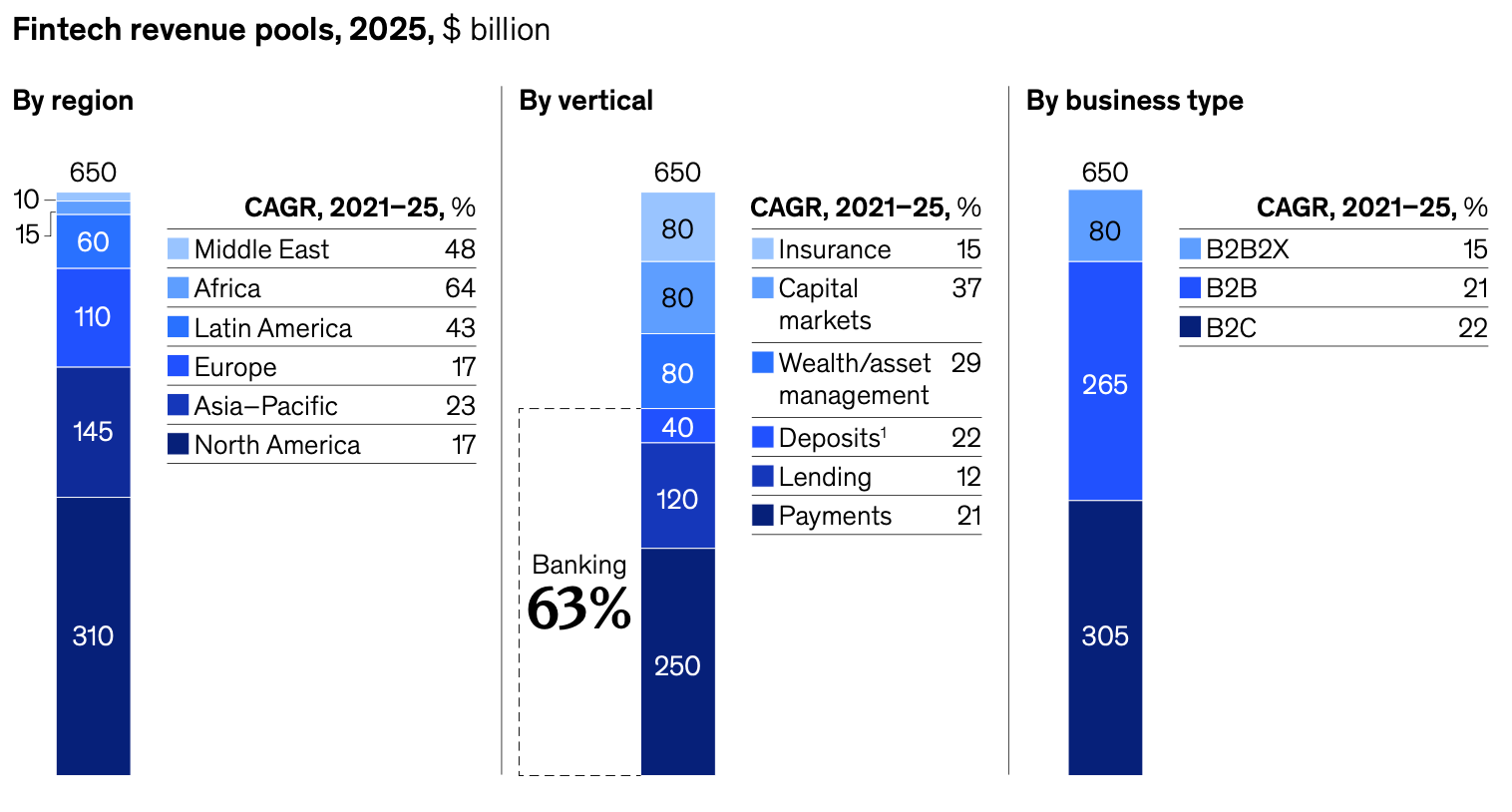
Fintech growth and value creation vary widely by vertical and geography, driven by structural inefficiencies and market opportunities. Payments remain the largest segment, generating around $250 billion in revenue and growing 18 percent year over year in 2024–25, supported by global players capturing digital and cross-border transaction flows. Lending follows with about $120 billion in revenue and 19 percent growth, fueled by expanding consumer and SME credit in underbanked regions through embedded finance models. Insurance and capital markets each account for roughly $80 billion, growing from a smaller base, with insurtech showing particularly strong momentum.
Regionally, North America leads with $310 billion in revenues, benefiting from deep capital markets and favorable regulation. Asia–Pacific generates about $150 billion, though growth has slowed to 15 percent. Europe remains smaller at $110 billion due to fragmentation and regulatory constraints. Latin America, at $60 billion, is the fastest-growing region, expanding 26 percent year over year by addressing financial inclusion gaps.
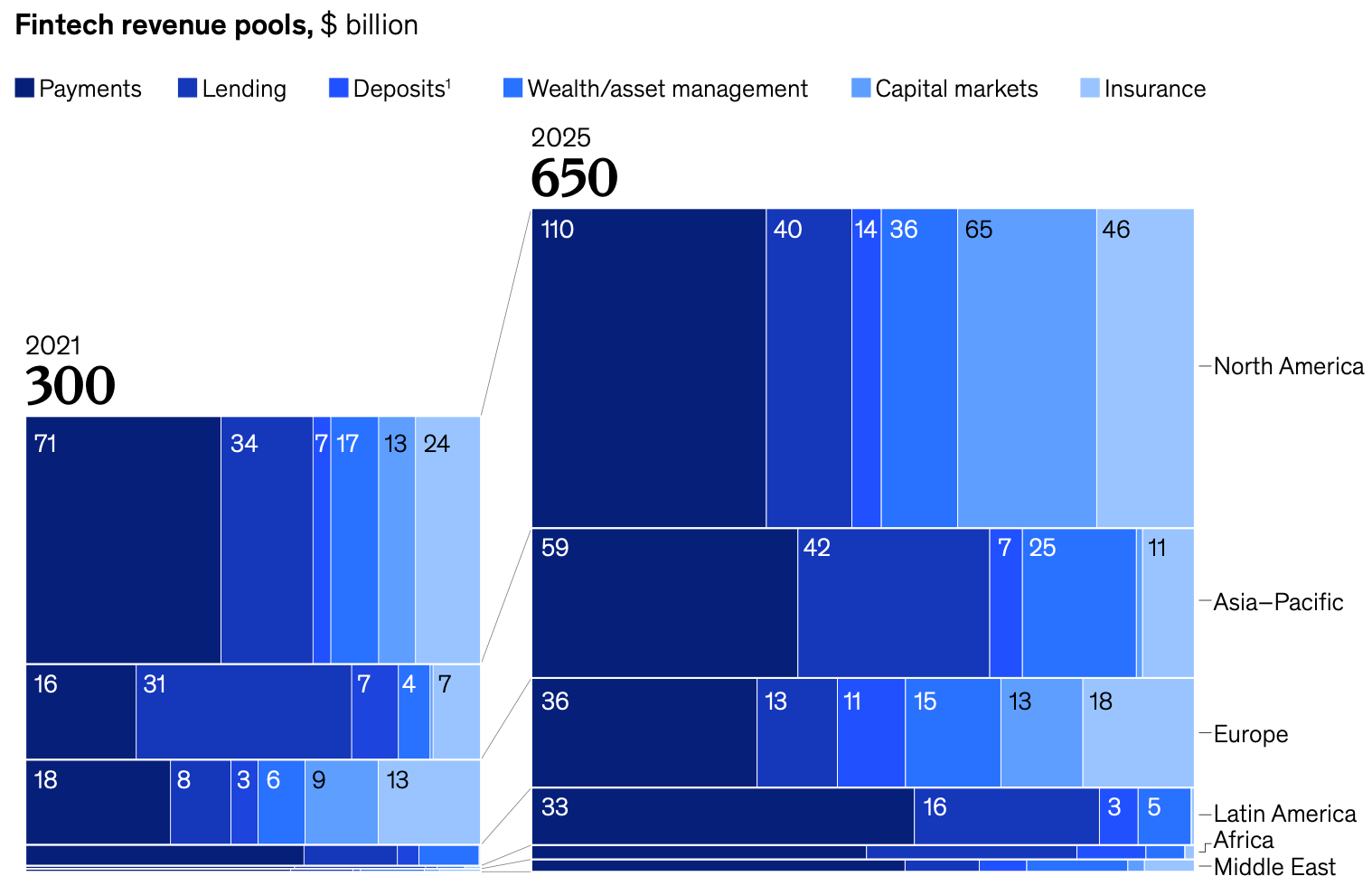
Fintech revenue distribution across regions and verticals reveals distinct structural patterns. In North America, the sector shows increasing maturity, with payments representing about 35 percent of revenues, while capital markets have expanded significantly to around 21 percent in 2025 from 8 percent in 2021, and insurance accounts for roughly 15 percent. This reflects a shift beyond payments into more complex financial segments.
In Asia–Pacific, the trend differs, with payments rising from 24 percent of revenues in 2021 to 40 percent in 2025, while lending declined from 47 percent to about 29 percent as credit markets matured. Lending remains more prominent in regions such as Africa, Asia–Pacific, and Latin America, where fintechs address gaps in credit access.
Capital markets fintech remains concentrated in developed hubs like London and New York. Meanwhile, horizontal fintechs, providing infrastructure and software to financial institutions, are expanding rapidly and accounted for about 13 percent of revenues in 2025, driven by demand for efficiency and regulatory compliance.
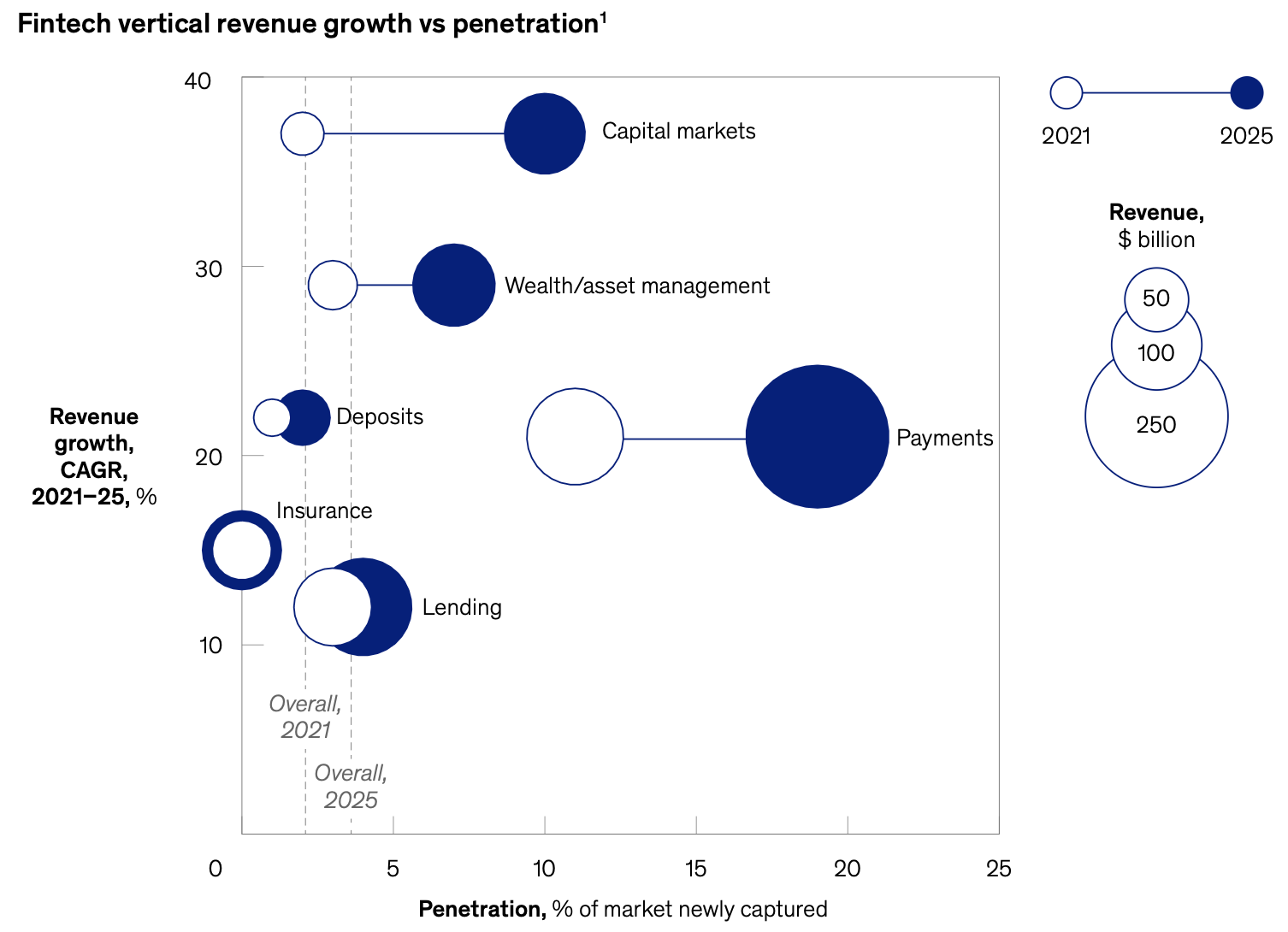
Despite recent expansion, fintech still represents only about 4 percent of global financial services revenues, leaving substantial room for further growth. The sector has gained the most traction in payments, where lower capital requirements and a modular structure have enabled rapid scaling, reaching roughly 19 percent market penetration.
Revenue capture is primarily driven by B2C and B2B models, contributing around 47 percent and 41 percent of total fintech revenues, respectively, as these players compete directly with incumbents through digital-first offerings. However, SME lending continues to lag due to high churn, limited scalability, and structural challenges. Successful models in this space are typically embedded within broader platforms rather than operating as standalone lenders.
Other verticals remain underpenetrated. Insurance, in particular, accounts for less than 1 percent of market share, constrained by heavy regulation, capital intensity, and the need for extensive historical data, which limits the ability of new entrants to scale efficiently.
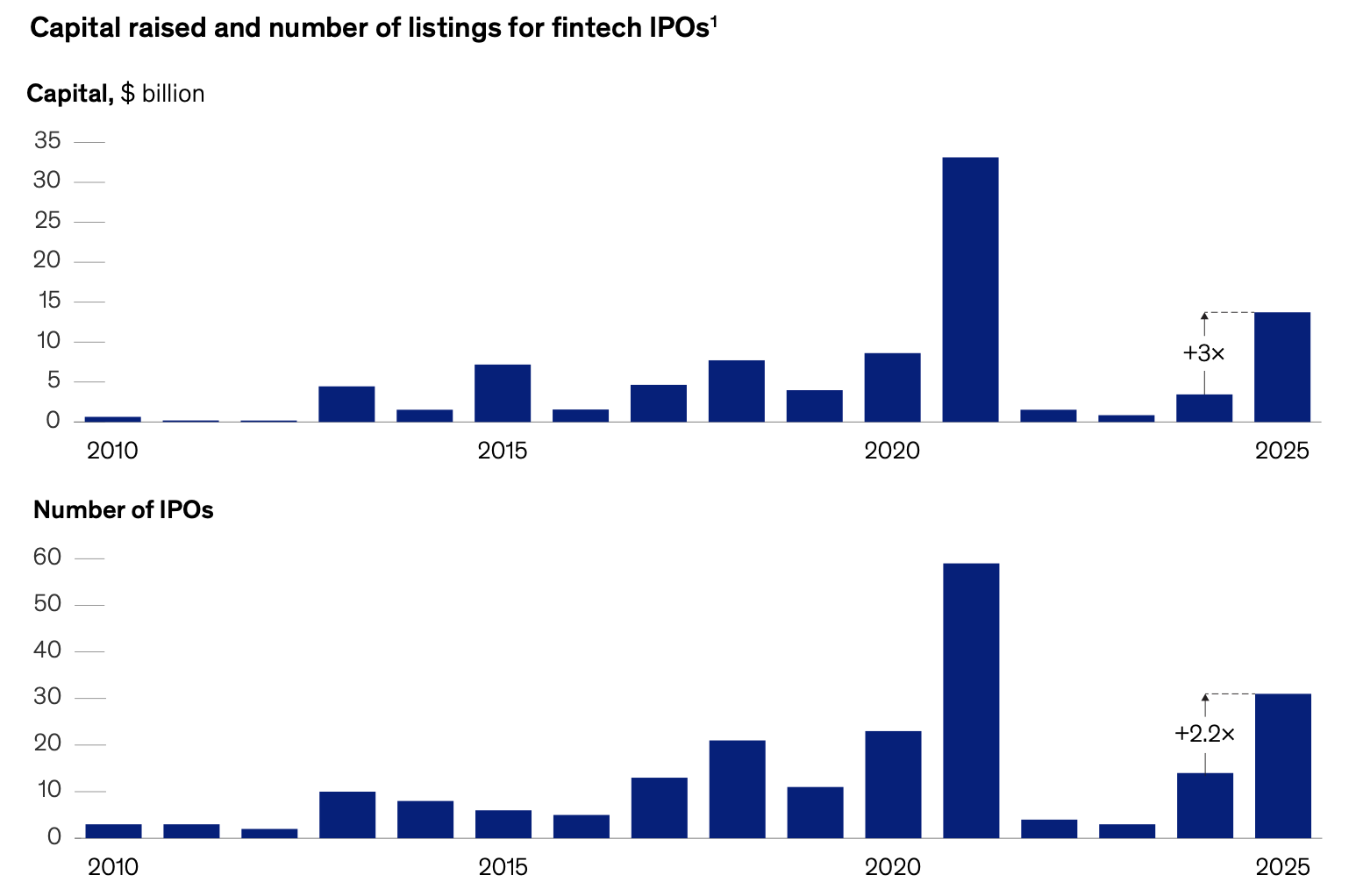
Fintech capital markets rebounded strongly in 2025, with exit multiples across venture capital and private equity rising above both the 2022–24 period and prepandemic levels. IPO activity surged, with 31 fintech listings raising nearly $14 billion, four times the capital raised in 2024 and almost double the strongest prepandemic years. Fintech companies represented about 12 percent of the total valuation among the 100 largest global IPOs, the highest share since 2021. Notable listings included Klarna, which raised $1.3 billion at an $11 billion valuation, Circle with $1 billion at a $20 billion valuation, and Chime raising $800 million at $11 billion.
Despite this recovery, investment patterns have become more selective. Capital is concentrated at two ends: large, profitable fintechs attracting strong demand, and early-stage ventures capturing about 37 percent of funding. Meanwhile, growth-stage investment has declined, increasing pressure on midstage companies to demonstrate sustainable profitability.
But let’s take a closer look at the main news of the last seven days. Revolut just opened their first physical shop in Barcelona, Bending Spoons target a potential $20B IPO, Nexi Group brings Wero to German eCommerces and Mercury got OCC approval to launch a national bank in the US. On top of that, CVC is considering buying Nexi to delist them, Tether.io launched a gold backed Visa card with Fasset, Mastercard became the official sponsor of Club Atlético Boca Juniors and Paytm lost its payment license in India. In the VC ecosystem, Earlybird Venture Capital closed a $360M fund to back deeptech European founders, Illuminate Financial raised a $135M fund to invest in fintech founders, but also new funds from KOMPAS VC, Mighty Capital, Ground State Ventures and Adams Street Partners. And finally, some very interesting funding rounds from fintech companies like tapaya., Marloo, PvX Partners, Kashable, Comfi.ai, Rogo, belo and many others.
Let’s take a closer look:
Rounds
- Comfi.ai secures $65M to expand B2B BNPL infrastructure across MENA
- 3F raises $4M to simplify leveraged access to tokenized real world assets
- Kashable raises $60M Series C led by Goldman Sachs to scale employer based lending
- Deutsche Börse Group leads $14M Series A in Performativ to scale AI wealth management platform
- Oolka raises Rs130 crore Series A led by Accel, valuation reaches Rs730 crore
- PvX Partners raises $10.5M Series A to scale non dilutive growth financing
- tapaya. raises €1M to turn any device into a payment terminal
- Marloo raises $10M to scale AI platform for financial advisers
- Credilio secures ₹100 Crore to scale FD backed credit card platform novio
- LemFi commits £100M to UK expansion as it relocates global HQ to London
- Rogo raises $160M series D to scale AI across global financial institutions
- belo raises $14M led by Tether.io to scale stablecoin payments across Latin America
- Liquid raises $18M to scale 24/7 cross asset trading platform
- XO Market raises $6M seed to open prediction markets to user generated trading
- NUVA Digital secures $5.2M seed round to scale tokenized real world asset marketplace
- pmtbox raises $15M seed to unify payments, risk, and data for enterprise merchants
- Santander commits $67M to Ebury in £550M funding to scale AI driven payments
- YamSoft deploys AI payment suite backed by €2.35M EU innovation grant
VC funds
- Adams Street Partners secures $2.5B for sixth co-investment fund
- Ground State Ventures closes €75.2M fund to scale early stage quantum investments
- Mighty Capital raises $91M Fund III to scale product led B2B investments
- KOMPAS VC closes €160M fund II to accelerate industrial tech innovation
- Illuminate Financial raises $135M to back series B+ fintech and enterprise AI leaders
- Earlybird Venture Capital raises €360M fund VIII to scale Europe’s deeptech and AI infrastructure
- BMW i Ventures launches $300M fund to back AI driven transformation in automotive and industry
- Off Piste Capital launches €25M fund to back next gen infrastructure startups
News on the market
- Bending Spoons targets $20B valuation in potential US IPO
- Mastercard partners with Club Atlético Boca Juniors to expand fan centric payment experiences
- Banca centrale europea advances digital Euro project in partnership with nexo standards and Berlin Group openFinance
- Reserve Bank of India (RBI) revokes Paytm payments bank license
- Banking Circle launches stablecoin clearing following CASP license approval
- China blocks Meta’s $2B Manus AI acquisition, forcing full deal unwind
- Mercury secures OCC approval to launch national bank and expand capabilities
- Revolut opens first physical store in Barcelona
- Tether.io and Fasset launch gold backed Visa card bridging payments and digital assets
- Nexi Group brings Wero to German eCommerce, expanding Europe’s A2A payments push
- CVC explores potential $9B take private deal for Nexi Group
- Ripple and OKX expand RLUSD access with global trading and liquidity integration
- MoonPay acquires Sodot and launches institutional platform led by former CFTC chair
- Thunes and WireBarley partner to power real time cross border payments for 1.1M users
- Meta launches USDC stablecoin payouts for creators via Solana and Polygon Labs
- PayPal spins off Venmo as standalone unit amid strategic restructuring and takeover interest
- Shopify expands fintech ambitions with nationwide money transmitter push
And here some useful resources for everyone involved in the ecosystem:
Events you don’t want to miss
- Stablecon EMEA | Amsterdam - 19th-20th May (Link here)
- Money 20/20 | Amsterdam - 02-04 June (Link here)
You have a cool event you want to mention or to sponsor? Feel free to send me a DM.
Founders to watch in fintech
I also wanted to start shining a light on the most interesting fintech founders out there, so I thought to start sharing how I look for ideas to invest on. Every week, I will start sharing the most interesting founders in fintech, divided per area.

This week we take a look at the most interesting founders in fintech in Nigeria.
I usually use Spectre to scout for new ideas, the team is great and they also give me a free account once they learned I was a fan of the product. So if you wanna take a look at it, you can find it here.
New funds
I would like to leave this part of the newsletter as space for VC and solo GP that are launching new funds right now. I frequently speak with GPs and LPs, and I like the idea of giving them a showcase where to announce what they are doing. Here the new funds raising right now that I have been talking with:
- Parallax Ventures, a fintech VC fund focused on Latam. They closed Fund I with a strong +50% IRR and 0.7x DPI, and are now raising Fund II. Take a look here if you want to know more or reach out directly to the GP at gennari@parallax.vc for details.
- Founder Factor, VC focused on YC companies, that just closed investments on the latest YC W26. They are expanding the current vehicle to double down on the current batch. Partner is Marco Scotti, you can take a look here if you are interested.
Overall, very interesting to see where the VC ecosystem is heading recently, between new emerging managers, solo GP and micro funds.
Always happy to support if I can under this point of view! If you are raising a fund and you want to be listed here send me a message on Linkedin.
And finally, take also a look at the last edition of the newsletter, Weekly update #129.
Topics
Related funding
| Company | Round | Amount | Date |
|---|---|---|---|
| novio Added · · Weekly update #130 | 1,000,000,000 INR | 29 April 2026 | |
| YamSoft Added · · Weekly update #130 | Grant | 2,350,000 EUR | 1 May 2026 |
| PvX Partners Added · · Weekly update #130 | Series A | 10,500,000 USD | 23 April 2026 |
| belo Added · · Weekly update #130 | 14,000,000 USD | 30 April 2026 | |
| tapaya. Added · · Weekly update #130 | Pre-seed | 1,000,000 EUR | 28 April 2026 |
| Oolka Added · · Weekly update #130 | Series A | 1,300,000,000 INR | 28 April 2026 |
| Marloo Added · · Weekly update #130 | Seed | 10,000,000 USD | 28 April 2026 |
| Rogo Added · · Weekly update #130 | Series D | 160,000,000 USD | 29 April 2026 |
| Liquid Added · · Weekly update #130 | Seed | 18,000,000 USD | 28 April 2026 |
| Ebury Added · · Weekly update #130 | 67,000,000 USD | 1 May 2026 | |
| Comfi.ai Added · · Weekly update #130 | Pre-Series A | 65,000,000 USD | 27 April 2026 |
| pmtbox Added · · Weekly update #130 | Seed | 15,000,000 USD | 30 April 2026 |
| Kashable Added · · Weekly update #130 | Series C | 60,000,000 USD | 28 April 2026 |
| Performativ Added · · Weekly update #130 | Series A | 14,000,000 USD | 28 April 2026 |
| 3F Added · · Weekly update #130 | Pre-seed + Seed | 4,000,000 USD | 23 April 2026 |
| XO Market Added · · Weekly update #130 | Seed | 6,000,000 USD | 30 April 2026 |
| NUVA Digital Added · · Weekly update #130 | Seed | 5,200,000 USD | 28 April 2026 |